
[The King has sought] absolute Tyranny over these States… [by] abolishing the free System of English Laws in a neighbouring Province,1 establishing therein an Arbitrary government, … a fit instrument for introducing the same absolute rule into these Colonies.
—The Declaration of Independence
The Loyalist Papers is a sustained exploration of North American political identity, rooted in the conviction that the American Revolution was not an inevitable triumph, but a colossally consequential fork in the road of global history.
The project uses the 85 essays of The Federalist Papers as a roadmap to articulate a modern view of the Loyalist tradition: a perspective that prioritizes institutional continuity; the stability of the Westminster system; and the peace, order, and good government that defines the Canadian experience. While the American Constitution of 1787 is often presented as the apex of political design, this project treats it as a singular hypothesis, one that has, perhaps, proven less durable than is typically acknowledged.
A Dialogue Across Time and Ideals
Unfolding over the 198 weeks of a single American presidential term (2025-28), the project reconsiders the foundational arguments of Alexander Hamilton, James Madison, and John Jay in view of the politics of the twenty-first century. It explores how the ideals of the American Framers measure up in an era of:
- Industrialized megacities where the agrarian, small-scale assumptions of 1787 are stretched to the limit by the complexity of modern urban governance.
- Technological acceleration, artificial intelligence, and the challenge of maintaining deliberative democracy and human agency in an era of algorithmic echo chambers.
- Mass communication that has blunted the attention spans of modern citizenries, threatening the slow, sober second thought required for constitutional stability.
- Globalized complexity and the vulnerability of a republican system designed for local commerce, now faced with integrated global supply chains and digital economies.
- Partisanship as warfare, where routine political disagreements have spiralled into an existential struggle to turn institutional checks and balances into weapons rather than shared traditions that forge national unity.
Together, these modern pressures contribute to a growing risk of institutional decay, calling into question whether the rigidly designed machinery of the American Republic can endure, or if the organic resilience of the Westminster system offers a more stable alternative.
The Sixteen Colonies

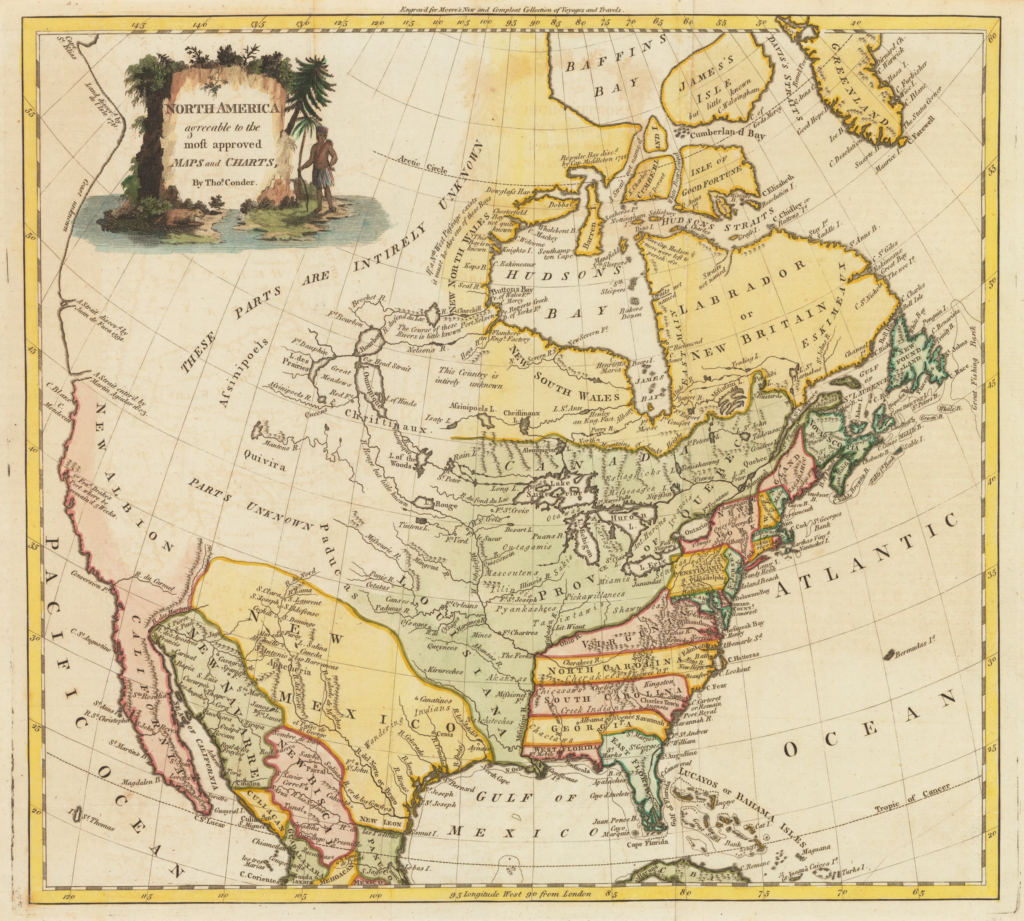
A central viewpoint of the project is that of the “Sixteen Colonies” of British North America.2 By re-centring the experiences of Québec,3 Nova Scotia,4 and Newfoundland5 alongside the Rebellious Thirteen, these Papers further explore the alternate history of a gradualist, Loyalist path to sovereignty – and the missed opportunity to build a truly continental confederacy founded upon the Crown-in-Parliament.
Give Me Life and Liberty
The Loyalist Papers is an invitation to consider whether the sturdiest bulwark of freedom and democracy may lie not in revolutionary zeal, but rather in the enduring principles of the Loyalist tradition. In this respect, the project offers more than a critique of The Federalist Papers; it provides a fresh framework for understanding – and perhaps surviving – the complexities of the twenty-first century.

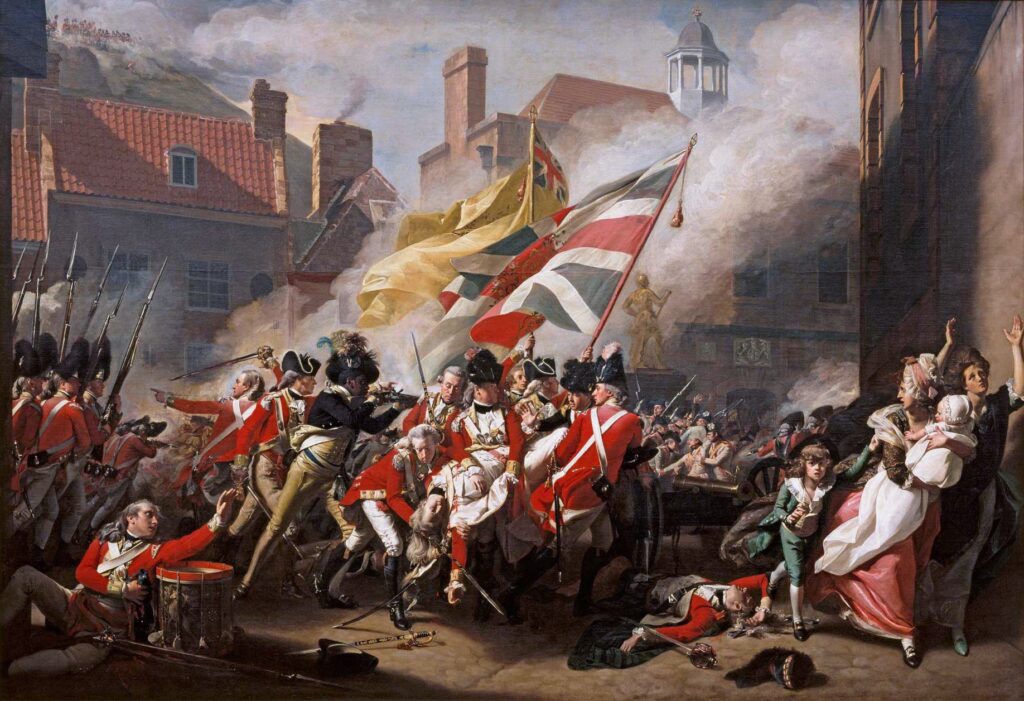
Cover image: “The Death of Major Peirson, 6 January 1781” by John Singleton Copley (1783). Oil on canvas. Tate Britain, London. Public domain. // British and Loyalist forces repelling a French assault on Jersey in the Channel Islands during the American Revolutionary War, a scene of sacrifice and fidelity to the Crown.
Footnotes
- i.e. Québec.
- While history often focuses on the “Thirteen Colonies” that signed the Declaration of Independence, the British North American reality of 1775 was a broader administrative tapestry. Of those entities that went on to form Canada, only Nova Scotia had an elected Assembly that operated in the same manner as the rebelling Thirteen States, while Québec and Newfoundland were governed through direct executive and legislative authority from London. The term “colony” is used here to denote these distinct jurisdictions under the British Crown, though their internal structures varied significantly.
- A particularly complex entity, Québec was governed under the Québec Act of 1774. Unlike the thirteen rebelling colonies, it operated under French civil law and lacked a representative assembly – factors that made it both a target for American “liberation” and a bastion of Loyalist stability. Its borders at the time extended deep into the Ohio Valley and the Great Lakes basin.
- In 1775, Nova Scotia was a large maritime entity. It encompassed not only the present-day province of Nova Scotia but also the territories of Prince Edward Island (then known as St. John’s Island) and New Brunswick. These regions would only be partitioned into separate colonies in 1769 and 1784, respectively, as a direct result of the Loyalist influx following the Revolution.
- Often regarded by historians like D. W. Prowse as a “great ship moored near the Banks,” Newfoundland was primarily a seasonal fishing station governed by naval admirals rather than a traditional colonial assembly. Its inclusion in the “Sixteen” highlights a strictly maritime Loyalist identity that was almost entirely insulated from the revolutionary fervor of the South.