Loyalist № 9
To the Peoples of North America, this being a Loyalist Response to Federalist No. 55:
W
hat the White House called “Liberation Day” The Economist called “Ruination Day.” On April 2, 2025, President Trump unilaterally expanded his North American trade war to countries around the world, including not just adversaries like China and Iran but also longtime allies in Europe and the South Pacific. Invoking emergency powers under the Cold War-era International Emergency Economic Powers Act (IEEPA), he imposed a sweeping 10 percent tax on all foreign goods entering the United States. The declared emergency? Persistent trade deficits.
Trump’s justification strains any plain reading of the IEEPA, which limits use of its emergency powers to “unusual and extraordinary” threats from abroad. That one man in the Oval Office might singlehandedly upend the entire postwar global economic order cannot possibly have been the intention of Congress when it enacted the statute in 1977. How, then, did Congress respond to this clear violation of its exclusive constitutional powers to regulate trade and commerce?1 No emergency sessions were called. No hearings held. No motions proposed. No votes scheduled.
Instead, a handful of members issued public statements: some indignant, some rhetorical, all inconsequential. No authority was reasserted, and so none was reclaimed. This is not the Congress the Framers imagined.
In Federalist No. 55, James Madison addresses what he calls one of the most contested features of the new Constitution: the initial size of the House of Representatives, set at just 65 members. Critics at the time evidently worried that such a small body would be too easily corrupted or controlled, or else too detached from the people to serve as a true representative assembly. Madison pushes back against these criticisms, insisting that the question isn’t really about landing on an optimal number. “Nothing can be more fallacious,” he writes, “than to found our political calculations on arithmetical principles.” Throughout the discussion, he offers a subtle vision of Congress as a legislative body capable of reasoned deliberation.
Madison’s vision is ultimately an optimistic one. “As there is a degree of depravity in mankind which requires a certain degree of circumspection and distrust,” he writes, “so there are other qualities in human nature which justify a certain portion of esteem and confidence.” The success of any representative form of government depends on balancing these competing impulses in human nature. The people, left to decide every issue directly, cannot be expected to govern wisely; wisdom requires judgment, and judgment requires deliberation – not just counting seats or votes, but refining public opinion into public reason.
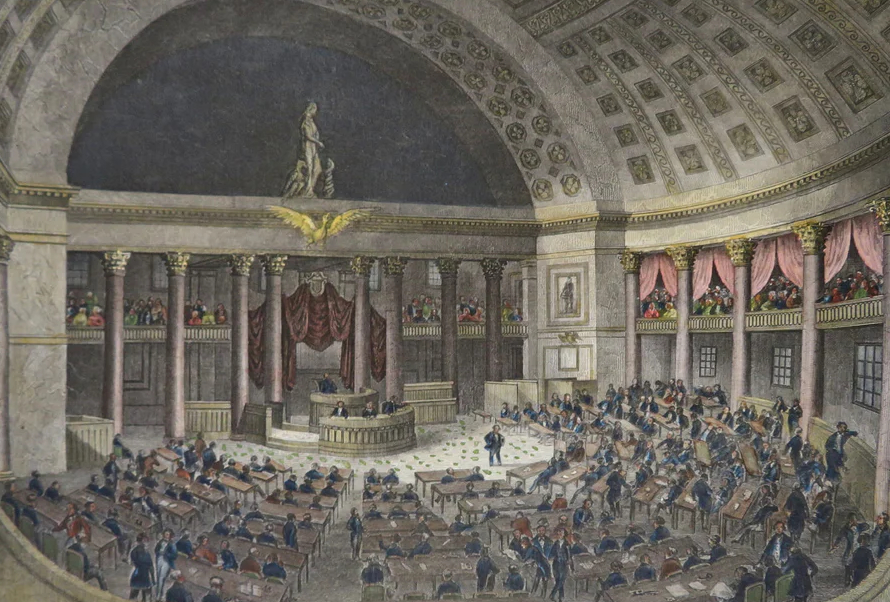
Representative democracy is the mechanism by which the will of the people is not merely aggregated, but thoughtfully considered. For Madison, the purpose of a representative assembly is not simply to duplicate public opinion and then translate it into policy wholesale, but to challenge it through reasoned exchange. The legislature, he writes, must be designed “to secure the benefits of free consultation and discussion,” while also guarding against “the confusion and intemperance of the multitude.” In both the American and Westminster traditions, the concept of deliberative democracy rests on the belief that truth emerges not from the loudest voice or the strongest faction, but through the friction of competing views. Deliberation on what makes good policy requires time, disagreement, and disciplined debate.
Yet thoughtful deliberation is never guaranteed. Madison understood that disorder can arise not only from bad actors, but from the dynamics of the assembly itself. In one of the most philosophically provocative passages of Federalist No. 55, he writes:
In all very numerous assemblies, of whatever character composed,2 passion never fails to wrest the sceptre from reason. Had every Athenian citizen been a Socrates, every Athenian assembly would still have been a mob.
His disdain for Athenian democracy aside, Madison’s point is not that virtue or wisdom are irrelevant, but that they are insufficient on their own to produce good outcomes in politics. However capable the individual members, reason will struggle to prevail in any assembly not structured to promote and support it. Without the restraints and procedures that make real deliberation possible, even a group of the most virtuous citizens is at risk of giving way to their common impulses. Conversely, it would seem that Madison also believed that an assembly of mediocre members, if thoughtfully structured, might still produce wise outcomes – an encouraging thought.
These considerations go well beyond Federalist No. 55 and the immediate question of how many members should sit in the House of Representatives. How to balance public opinion with reason, the will of the people with the common good, individual liberty with collective authority – these are perhaps the central questions of the Federalist Papers taken as a whole. For now, Madison is suggesting that an effective deliberative assembly must be large enough to reflect a diversity of interests and perspectives while also guarding against factional dominance, yet still small enough to allow for genuine, ordered debate. Unsurprisingly, Madison concludes that 65 Representatives is sufficient for the scope and scale of the Thirteen States in his own time, so long as it would grow in proportion with the country’s population and territory.
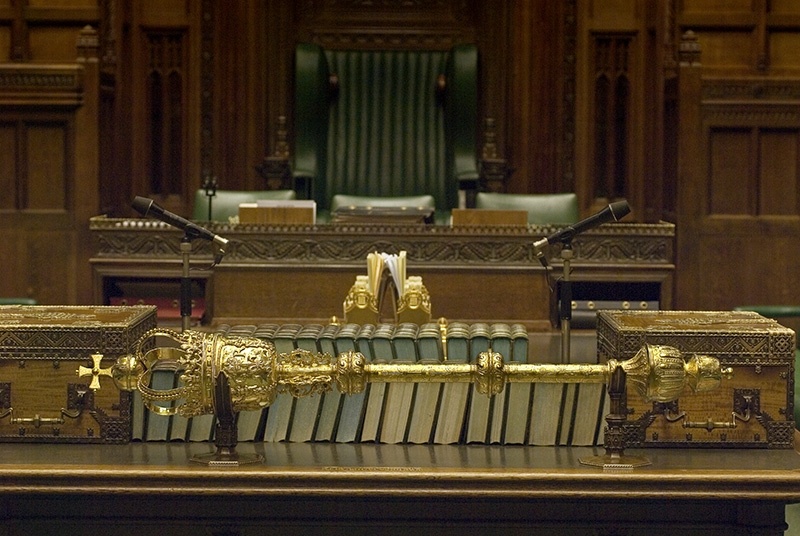
Today, the U.S. House of Representatives is capped at 435 members.3 Canada’s House of Commons now has 343 members; the United Kingdom’s has 650. These are all much larger than the Framers might have deemed prudent. Madison’s central fear in Federalist No. 55 was that assemblies of this size might descend into chaos – that the voice of reason would be drowned out by the passions of the many. Ironically, in these larger assemblies today, dysfunction is more often attributable to the opposite problem: not an excess of passion but a deficiency of reason.
In Our House of Commons, party discipline has all too often compelled individual members to subordinate their own judgment, and the values and priorities of their constituents, to the authority of the party leader. In his infamous “nobodies” comment, Prime Minister Pierre Trudeau gave voice to this point rather bluntly. In reference to an adjournment of the House in 1969, he said of MPs:
When they get home, when they get out of Parliament, when they are 50 yards from Parliament Hill, they are no longer honourable members – they are just nobodies.
Prime Minister Pierre Trudeau, 1969.
Whether intentionally or not, Trudeau was articulating the inverted logic that MPs effectively serve as party emissaries to their ridings, rather than representatives of their constituents in Parliament.
Trudeau the Elder’s inversion of representative democracy is reinforced by the regular use of “whipped votes” – enforcement of the party line under threat of sanction and even expulsion. So-called “free votes,” in which MPs vote according to conscience or conviction, remain rare exceptions. In addition, cabinet dominance in the House, particularly under majority governments, further constrains parliamentary debate: backbenchers, rather than challenging the government line, often seek to ingratiate themselves to party leadership out of careerism, seeking better pay, perks, and power.
Some have argued, if not entirely consistently with Madison’s reasoning, that a larger House might help alleviate these problems by reducing the influence of party discipline. In a bigger assembly, it becomes more difficult for party leadership to monitor and control every member – especially backbenchers, who, given the size of the chamber, would have fewer opportunities to join cabinet and may therefore feel freer to speak their minds. A larger and more internally diverse legislature would also open more space for dissent, independence, and genuine debate. Of course, as Madison reminds us, a larger assembly will not improve the quality of deliberation if it is not accompanied by broader reforms to parliamentary culture and procedures that actively encourage restraint and independence.
In many ways, the United Kingdom’s “Mother of Parliaments” offers an ideal of deliberative Westminster democracy – one that Canada would be wise to emulate more closely. Despite having nearly twice as many members, the UK House of Commons has, contrary to Madison’s expectations, sustained a long tradition of independence, eloquence, wit, and decorum among its members. All of these qualities were on fierce display in Sir Geoffrey Howe’s resignation speech in 1990, delivered from the backbenches following his departure as Deputy Prime Minister in Margaret Thatcher’s final government. His speech was dramatized to great effect in Season 4 of the Netflix series The Crown:
That speech was not just a devastating rebuke of Thatcher’s leadership style and national policies vis-à-vis Europe, but a lasting example of what parliamentary speech can achieve when it is used not to posture, but to persuade. Sir Geoffrey’s words are a powerful reminder that Parliament can – even in moments of crisis – still deliberate.
Madison’s House of Representatives was meant to foster even greater independence than its British roots might have seemed to allow. Because of the separation of powers, its members are less beholden to party leaders for advancement. They cannot lightly be dismissed from office or expelled from their party. Their terms are fixed, their salaries secure, and their authority under Article I of the Constitution considerable. Yet for all this structural independence, the modern Congress rarely produces anything like a Sir Geoffrey Howe moment – an instance of moral clarity, rhetorical seriousness, and genuine deliberative weight.
Today, Representatives speak but rarely persuade. They debate but rarely reach agreement. They table motions but rarely achieve outcomes that are not preordained. What has been lost is not formal legislative power, but the very ethos of deliberation itself. In a republic, speech should serve not merely to express an opinion, but to test it, to refine it, and ultimately to decide on a course of collective action.
Only hours after President Trump declared economic war on the world, the United States Senate convened to pass a bipartisan bill to rescind at least some of the tariffs imposed by executive order under the IEEPA’s emergency powers. The bill, supported by four Republicans along with all Democrats, would reclaim congressional consent for imposing tariffs on grounds of national security.
A short time later, Speaker Michael Johnson announced his support for President Trump’s executive trade action and signalled that he would not be bringing the Senate bill to a vote on the floor of the House. He did not declare his position from the Speaker’s chair, nor in debate, nor anywhere else in the Congressional Record. He posted it on Facebook. ♛


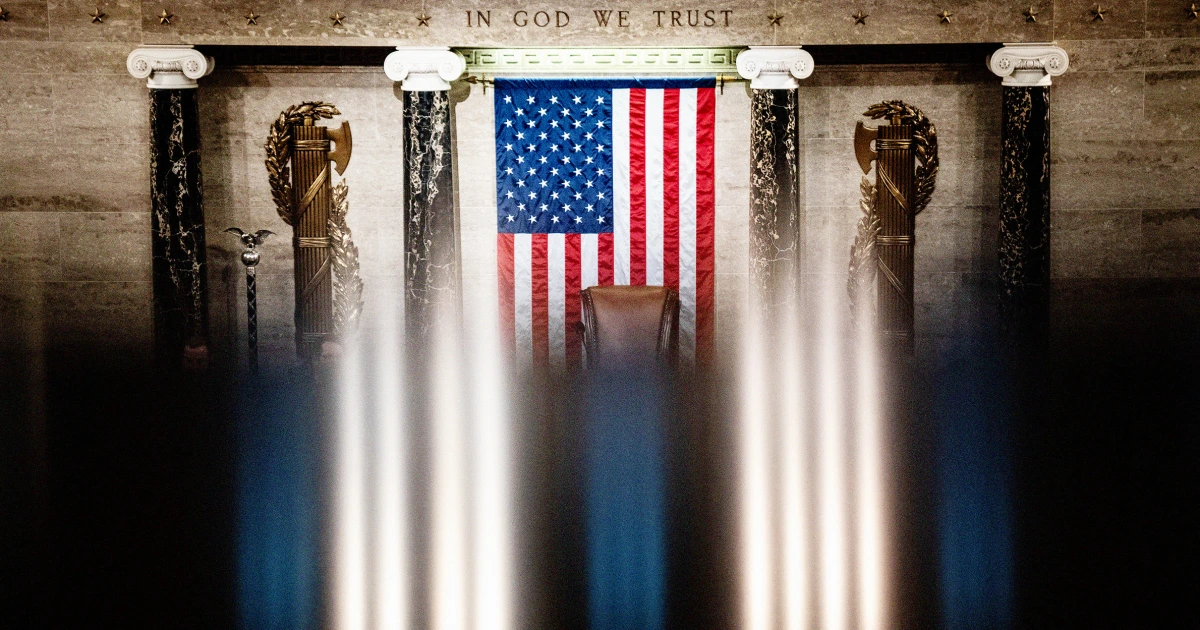
Cover image: The Speaker’s chair standing empty in the chamber of the United States House of Representatives. Photo by Anna Moneymaker (2023). Courtesy of Getty Images. // This image was taken amid a historic contest: it took 15 ballots over four days in January 2023 for Kevin McCarthy to be elected Speaker. It was the first multi-ballot speaker election since 1923 and the longest since longest since 1859–60, just before the outbreak of the Civil War.
Footnotes
- Article I, Section 8, Clause 3: “The Congress shall have Power… To regulate Commerce with foreign Nations, and among the several States, and with the Indian Tribes.
- Emphasis added.
- Per the Permanent Apportionment Act of 1929.