Loyalist № 14
To the Peoples of North America, this being a Loyalist Response to Federalist No. 28:
O
ne morning a box truck pulled up near the front of the Alfred P. Murrah Federal Building. The truck was a red-and-white rental from Ryder. It was a Wednesday, just before 9:00am. The date was April 19, 1995 – Patriots’ Day – the anniversary of the first shots of the American Revolution. But this was not Lexington or Concord; it was Oklahoma City. The driver was Timothy McVeigh.
When the homemade fertilizer bomb exploded it tore off the entire face of the nine-storey edifice. The explosion killed 168 people, including 19 children. Another 800 were injured. Even today, the event remains the single most devastating homegrown terrorist attack in the entire history of the United States.

McVeigh was arrested less than two hours later – at a routine traffic stop. When he was taken into custody, McVeigh was wearing a shirt emblazoned with the words sic semper tyrannis. Those same words were adopted as the official motto of the rebel state of Virginia at the outset of the Civil War. They were also the last words that President Lincoln ever heard.1

McVeigh was part of an underground network of white Christian nationalists. They justified their violent agenda not only as a natural right, but as a constitutional duty. That idea, long latent in American thought, is clearly articulated in Federalist No. 28. “There might sometimes be a necessity,” Hamilton argues, “to make use of force constituted differently from the militia.” Sensing, perhaps, the tensions in his own argument with the spirit of the Revolution of 1776, he quickly pivots to frame these necessities as a federal responsibility under the Constitution to quell “insurrections and invasions.”
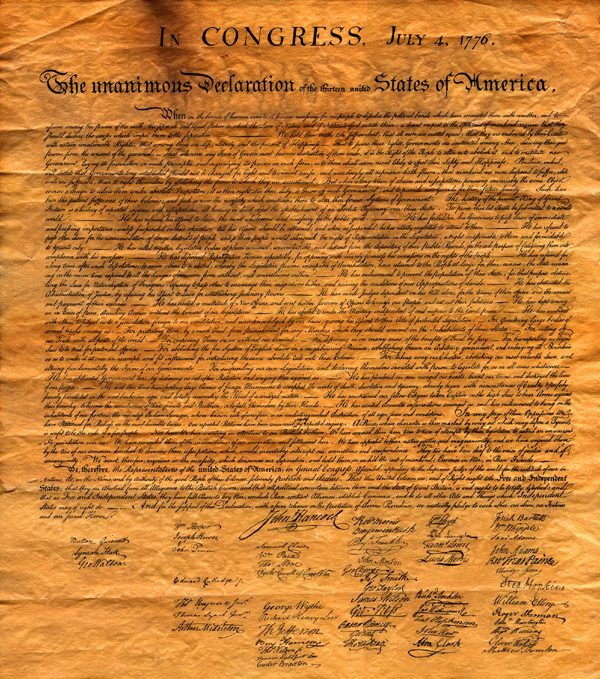
Was this not precisely what the Loyalists had done in defence of the Crown in 1776? Yes – but a more generous reading of Hamilton must acknowledge the zeitgeist of the Enlightenment that the Founders captured in the Declaration of Independence: that “Governments are instituted among Men, deriving their just powers from the consent of the governed.”2 Sovereignty flows from the people, not from the Crown. This alone affords the people a natural right of resistance.
While that right is preserved in the Constitution, Hamilton argues that it is restrained by reason in three ways. First, the Constitution institutes a government the “whole powers” of which will be “in the hands of the people.” The House of Representatives, as the popular legislative branch, expresses the will of the people and provides a lawful channel for resolving differences. Second, the dual structure of federalism ensures that the state and federal governments serve as mutual checks on one another, with the states retaining enough authority to resist federal usurpation – long a cause of anxiety among the Constitution’s critics. Third, the “great extent of the country” makes it difficult for a central authority like the federal government to suppress a widespread rebellion that, in pragmatic terms, might be presumed to be justified.
The design of the Constitution, then, ensures the people retain their natural right to withdraw their consent should “the representatives of the people betray their constituents.” Alas, upon whose weighty judgment are such incendiary conclusions to be drawn? Pervading Federalist No. 28 is the thinking of the American Revolution, left uncited – and perhaps for good reason. For Hamilton’s aim here is to frame a defence of resistance within the boundaries of law and order, even as he gestures toward a right that was born in violence, not reason.
In 1775, popular militias were forming across the Thirteen Colonies, pledging allegiance not to lawful colonial governments constituted under the Crown but to the revolutionary Continental Congress in Pennsylvania. New York Loyalist Samuel Seabury despaired:
I cannot conceive a worse state of thraldom, than a military power in any government, unchecked, and uncontrollable by the civil power. And this must be the case, with respect to a militia upon such an establishment as that of Maryland and New England. The laws of the [Continental] Congress, not the laws of the province, will be the rule of its conduct. Enthusiastic delegates, and brain-sick committee-men, will be its commanders; and the friends of order and good government, the devoted victims of its power.3
Seabury, a prominent critic of Alexander Hamilton, saw the logical endpoint of the Revolution. When every man reserves to himself the right to judge the lawfulness of government action, what ensues is not Lincoln’s later articulation of “government of the people, by the people, for the people.” Instead, political violence justified on the basis of personal conscience leads inevitably to the fragmentation of political order and so to anarchy.
Indeed, there is no small irony in the fact that Lincoln uttered those famed and honourable words at Gettysburg in 1863, naming “the last full measure of devotion” given by Union soldiers on the bloodiest day of the American Civil War.4 The Confederate States justified their secession in 1861 using reasoning not unlike Hamilton’s – though his was more cautious and implicit – in defending the American Revolution and, more directly, in asserting the limits of federal power on the basis of states’ rights.
Nor is it any small irony that Lincoln himself, the duly elected President of the United States, was assassinated by a man claiming to act against tyranny in defence of liberty. Hamilton ends Federalist No. 28 with a rhetorical flourish that in many ways anticipates both the Civil War and Lincoln’s murder:
When will the time arrive that the federal government can raise and maintain an army capable of erecting a despotism over the great body of the people of an immense empire, who are in a situation, through the medium of their State governments, to take measures for their own defense…?
The answer: Never. To the Confederates and John Wilkes Booth, it is the people – not the government, and certainly not the Crown – who wield sovereignty. They have a natural right, not merely of resistance but of armed rebellion. Sic semper tyrannis.
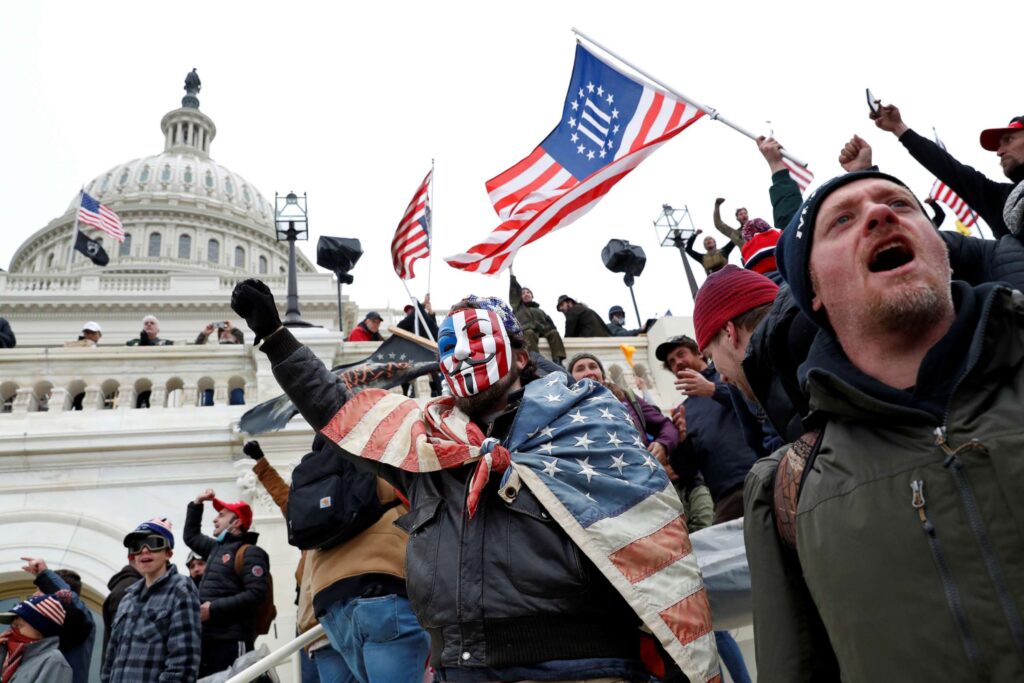
How could it be otherwise for a country founded on that very principle? From Concord to Lexington, from Fort Sumter to Ford’s Theatre, from Waco to Oklahoma City, American history presents a long and lamentable catalogue of ever more fragmented groups waging their own moral campaigns of violence in the name of freedom and the Constitution. Throughout Federalist No. 28, Hamilton routinely returns to the language of contagion and disease to describe this kind of unlawful violence, warning of “unceasing agitations and frequent revolutions which are the continual scourges of petty republics.”
Two hundred and fifty years after Hamilton and Seabury – after the Revolution that gave to every man a crown – now, today, there remains, in the dark shadow of January 6, the promise of unending revolt and the looming spectre of a war of all against all.
Heavy are the heads that wear these crowns. ♛


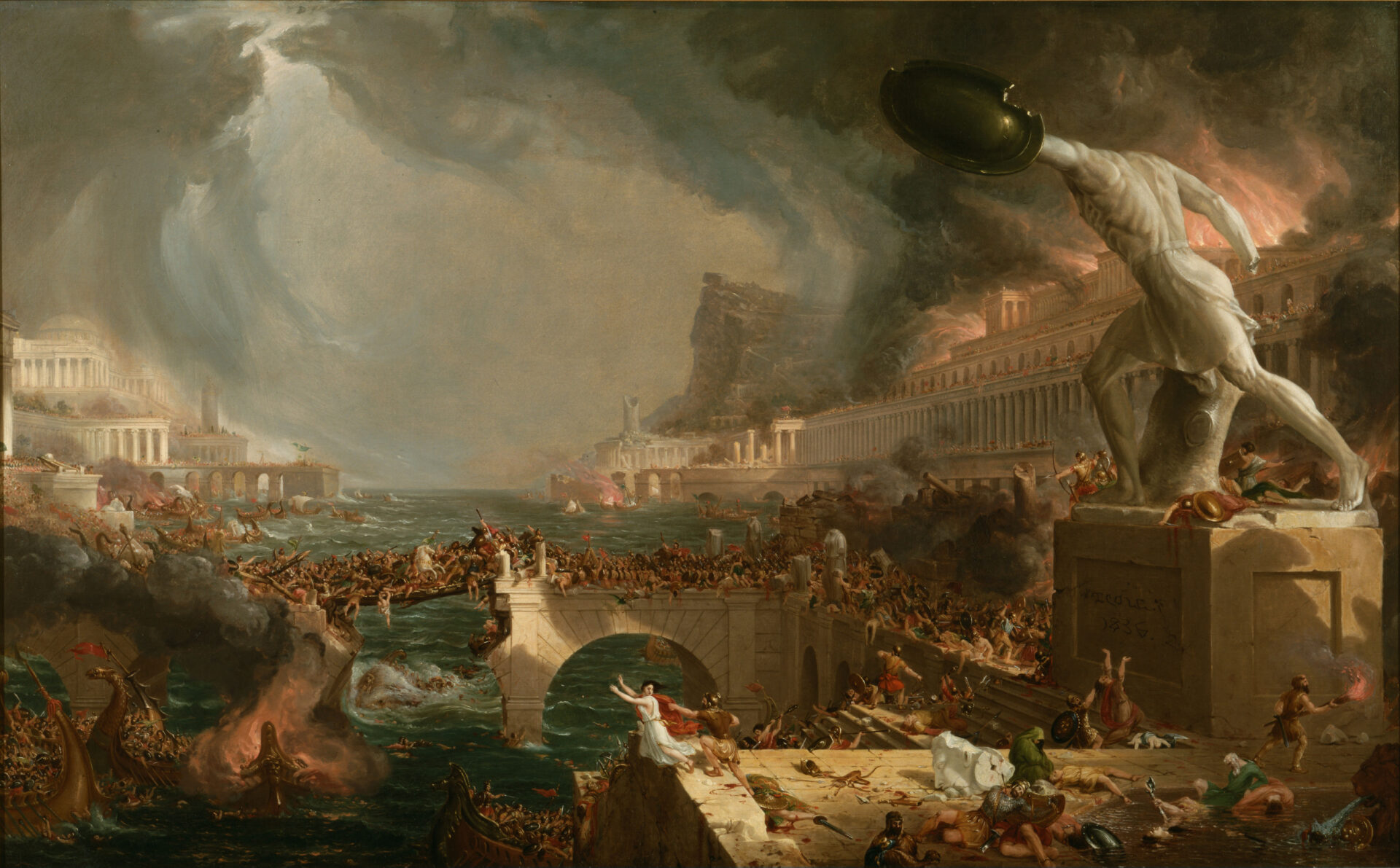
Cover image: “The Course of Empire: Destruction” by Thomas Cole (1836). Oil on canvas, part of Cole’s five-painting Course of Empire series (1833–36). Collection of the New-York Historical Society. Public domain.
Footnotes
- Two excellent documentaries on the bombing have recently been produced, one by Netflix and the other by HBO: Oklahoma City Bombing: American Terror (2025) and An American Bombing: The Road to April 19th (2024).
- See https://www.archives.gov/founding-docs/declaration-transcript.
- See Letters of a Winchester Farmer No. 4 (January 17, 1775).
- Remarkably short at just 272 words, Lincoln’s Gettysburg Address is one of the greatest speeches ever given.
I appreciate your answer of “never,” but I’m afraid that time may be upon us. While the New Right in America describes the centralization of executive power as a correction from the post-Watergate world, it is truly an imbalance that would have offended the founders. The idea of the U.S. as a confederation ended after the Civil War, but democracy and adherence to laws and norms of civil society provided reassurance that those constitutional defence options were unnecessary.
Now, the law doesn’t much matter anymore. The current U.S. executive is on the precipice of simply ignoring a Supreme Court ruling, and have only been spared having to make that outrage by a court currently inclined to give the president everything he wants.
America’s worship of its constitution belies how inoperable it has become. The justifications for the second amendment, espoused by the founders, would naturally allow for the personal ownership of stinger missiles and attack drones today. It’s not unfathomable a court could decide as much. If a constitution is broken, so is a country.
Thank you for reading! Your commentary helps bring into focus two things that Hamilton gets wrong in Federalist No. 28.
First, Hamilton imagines that an extensive republic spread across the continent could never be tyrannized by a single central authority, at least not without provoking a widespread organized resistance. The nature of the modern administrative state might well have surprised the Founders, and it’s clear they never could have imagined a country, much less a world, where information – and military orders – can be transmitted at the speed of light. So he’s wrong on the third point We noted about his argument in this Paper.
Second, Hamilton and the other Founders failed to imagine what the weaponry of the future might look like. They were living at a time when the deadliest weapons available were muskets and cannon – the former were easily carried by individuals, the latter certainly not. The Second Amendment now applies to a time when entire cities can be destroyed with a single bomb, packed into a truck very much like the one McVeigh rented, and intercontinental missiles can strike a target on the other side of the planet with deadly accuracy. There’s no longer any question that a central authority like the U.S. federal government would face few obstacles asserting and maintaining absolute control if it so chose.
Now, in fairness, the Founders saw themselves as establishing not a government for all time, but rather a process of governance that would adapt to the times. They didn’t pretend to be historical forecasters. Indeed, this is one reason why Hamilton, Madison, and Jay all opposed the adoption of a Bill of Rights at the Constitutional Convention: they felt it would constrain good governance. (See Federalist No. 84.) American politics today, and Oklahoma City, would look very different were Congress able to intervene in the largely unfettered right of individuals to carry automatic weapons.
All of this only further bolsters your last point that American government under the Constitution today bears little resemblance to the vision most of the Founders had of a grand Republic founded on principles of liberty, democracy, and the rule of law.
—Gloriana.