
Loyalist № 13
To the Peoples of North America, this being a Loyalist Response to Federalist No. 78:
T
he Federalist Paper most cited by Justices of the United States Supreme Court is also one of the collection’s most disingenuous. Framed as an exposition on the nature of the judicial branch, Federalist No. 78, written by Alexander Hamilton, is fundamentally a defence of judicial review: the right, if not indeed duty, of the courts to scrutinize the actions of the other branches and determine whether they conform to the Constitution.
Hamilton makes the argument in three parts. First, the American people ratified the Constitution. Because power flows directly from them, their delegates – Representatives, Senators, and even the President – cannot undo what they themselves have done. The Constitution therefore is the highest law. This means, in turn, that the judicial branch, while unelected, has a responsibility to strike down unconstitutional laws passed by the elected legislature and overturn arbitrary decisions of the executive. The courts, in other words, are positioned as guardians of the ultimate will of the people.1
Second, the American system of government is built upon a strict separation of powers, in which each branch derives its authority from a distinct constitutional function. The executive wields the sword: it enforces the laws and commands the machinery of state. The legislature controls the purse: it appropriates funds and sets the terms under which the executive may use them. The judiciary, by contrast, wields the powers of neither force nor finance. Hamilton characterizes the judicial branch as having “neither FORCE nor WILL, but merely judgment.”
On these grounds, Hamilton extends his case to argue, third, that “the natural feebleness of the judiciary” requires that it be empowered vis-à-vis the other two branches, all three of which are meant to be co-equal. If they are to balance and check one another, the judicial branch must be constituted by the other two. It must then be insulated from politics thereafter through the security of lifetime appointments. This will allow the highest judicial authorities the independence and security they will need to strike down laws on the basis of reason alone and weather the transitory “ill humors” of majoritarian politics.

The reasoning in Federalist No. 78 is unconvincing. Ever the lawyer, Hamilton’s arguments read like the closing statement at trial on behalf of a plainly guilty client: confident, practiced, but straining credibility.

The fact is that the judiciary does, and by design, wield enormous power. Precedent-setting cases like Chisholm v. Georgia (1793), Hylton v. United States (1796), and Calder v. Bull (1798) – all of which were decided within Hamilton’s lifetime and not long after the ratification of the Constitution – showed the highly contested nature of power in the judicial branch. Even more, these early cases pushed the boundaries of judicial restraint from the very outset. Under Chief Justice John Marshall, himself one of the Founders, the Court combined constitutional principle with political savvy in an effort to establish its legitimacy.
That same trend would continue well after Hamilton: Marbury v. Madison (1803), Dred Scott (1857), Brown v. Board of Education (1954), Roe v. Wade (1973) – and then Dobbs (2022) – United States v. Nixon (1974), Bush v. Gore (2000), Citizens United (2010), and Obergefell (2015). All of these cases dramatically transformed the powers of the other two branches of government. And so it would seem at the time Hamilton was writing that critics of the Constitution were right to be skeptical.
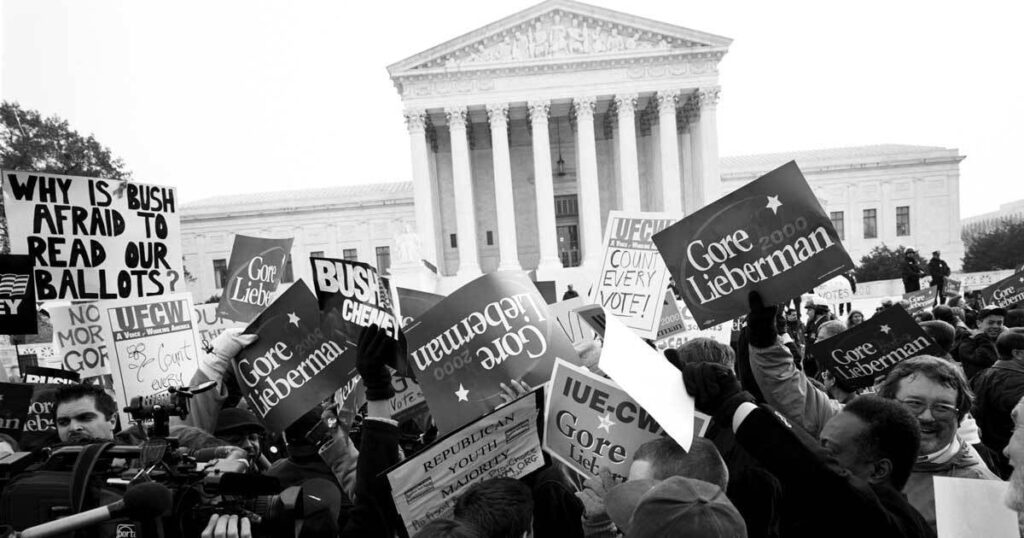
Beginning perhaps in 2000 with the highly controversial Bush v. Gore, which decided the outcome of that year’s hotly contested presidential election, judgments of the Supreme Court have become increasingly polarizing, both on the bench and in the streets. The same can be said of the process for appointing justices to the court. The Republican-controlled Senate’s refusal in 2016 even to consider President Barack Obama’s nomination of Merrick Garland was a nakedly cynical power play to keep a vacancy on the bench in the hopes of later tilting an otherwise balanced court toward its conservative faction.2
The conservative tilt of the court was solidified by the end of Donald Trump’s first term. In 2018 Brett Kavanaugh replaced the centrist Justice Anthony Kennedy, who had typically mediated (some might say waffled) between the conservative and liberal factions. The appointment of Amy Coney Barrett in late 2020 following the death of liberal icon Ruth Bader Ginsburg broke with longstanding norms of bipartisan restraint3 and established a decisive 6-3 conservative majority. Two years later the Dobbs decision overturned legal access to abortion, which had been recognized as a constitutional right for nearly half a century.
Dobbs was hailed by Republicans and social conservatives as a long overdue political victory – and the case perfectly refutes Hamilton’s claim that “the judiciary, from the nature of its functions, will always be the least dangerous to the political rights of the Constitution; because it will be least in a capacity to annoy or injure them.” His argument cleanly ignores the political reality that the “mere judgment” of the courts must necessarily either stymie or enable the actions of the other two branches by setting the boundaries of their powers. The instant those judgments come to be based on ideology or partisan alignment, the courts cease to be neutral arbiters and become political actors just like any other.
Recent polling shows a worrisome trend: Americans are increasingly coming to view the Supreme Court not as a neutral arbiter that operates on the basis of objective reason, but as a fundamentally political branch of government. Just one in five believe the Court is politically impartial, and opinions divide sharply along partisan lines. Two-thirds of Republicans view the institution favourably, while only one-third of Democrats do. These numbers point to a growing crisis of confidence in the ability of the judicial branch to perform its constitutional function as the Founders envisioned it.4

The uncomfortable truth that Hamilton sidesteps in Federalist No. 78 is that the power of the judiciary ultimately flows from its popular legitimacy as a branch of government that stands above the fray of day-to-day politics. Hamilton, to his credit, does not actually deny this point. But he places too much faith not only in the Constitution’s ability to safeguard the independence of the courts, but in the actors of the other two branches to recognize just how important preserving an apolitical judiciary is for good government.
The legitimacy of power depends on the people having trust and confidence that it is being exercised in a way that promotes the public good. In the case of the judicial branch, this means the people must believe that the judgments of the courts are impartial, reasonable, and grounded in the rule of law. Hamilton does his best to align the Constitution’s judicial powers with the legitimacy of past precedent: “in more States than one” have Americans already seen the benefits of impartial courts, he says, based on judges holding office according to the good behaviour standard. In this vein the federal Constitution simply extends good practice that is already in use across the Thirteen States.
And yet Hamilton, too – astonishingly – concludes Federalist No. 78 with perhaps the most reverent commentary that any revolutionary has ever paid to a former colonial master:
There can be no room to doubt that the [constitutional] convention acted wisely in copying from the models … that so far from being blamable on this account, their plan would have been inexcusably defective, if it had wanted this important feature of good government. The experience of Great Britain affords an illustrious comment on the excellence of the institution.
Only here, at the very end of Federalist No. 78, do We fully grasp Hamilton’s ambivalence. On the one hand, he argues that the Constitution represents a rational break from the past; while on the other, he argues that it faithfully preserves the best features of English law, the rejection of which was the whole point of the American Revolution.
The long arc of English legal history has, in general, been a story of constraining and rationalizing executive power. From Magna Carta in 1215 through to the Glorious Revolution in 1688 and afterwards, the Crown gradually ceded authority to lords, parliaments, and courts. History – not rebellion – disciplined the exercise of arbitrary power in Britain.
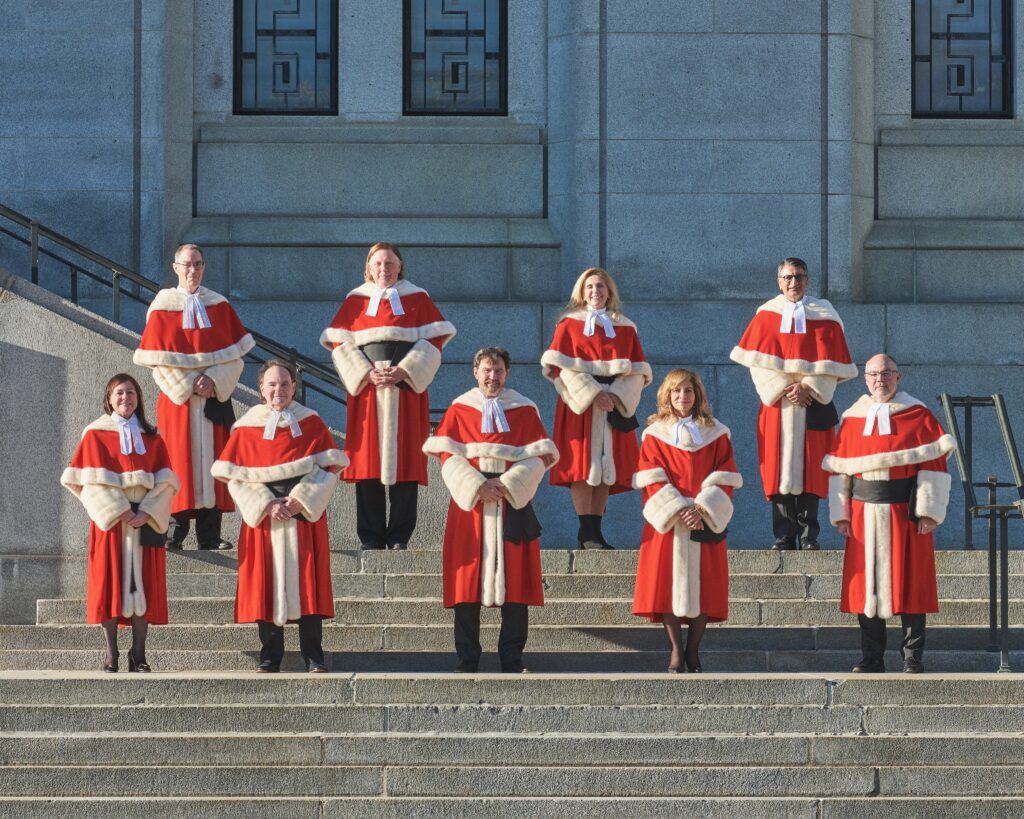
And so this today is the inheritance of all Commonwealth realms: that the Crown, through a long history of conflict, negotiation, and restraint, has become an apolitical, reasonable, and impartial institution – and that only under the Crown do Our courts stand as the ultimate arbiters of peace, order, and good government. God save the King and the King’s judges. ♛


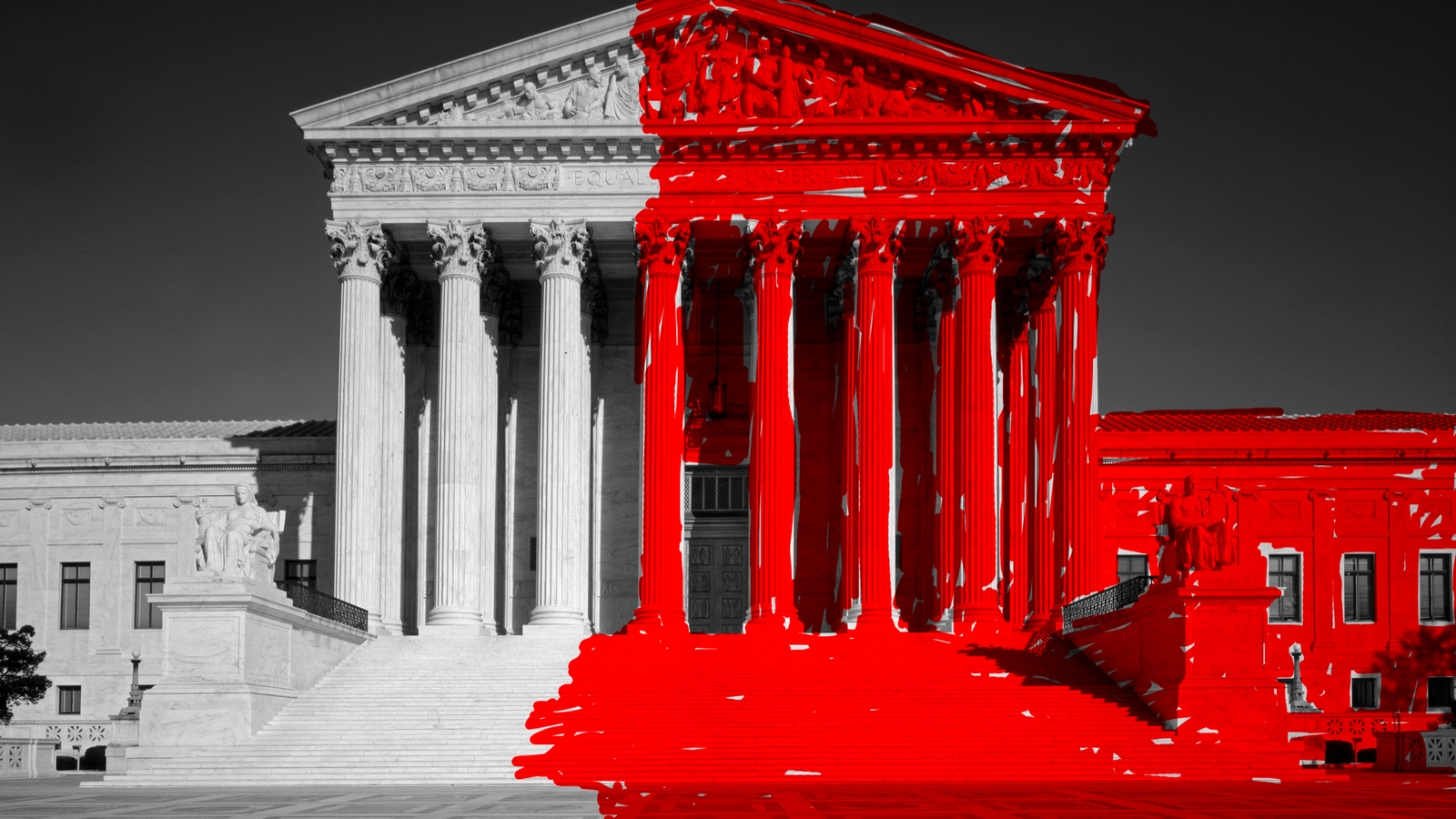
Cover image: Illustration of the U.S. Supreme Court by Tracy Ma for The New York Times Magazine (2018).
Footnotes
- It should not escape notice that the U.S. Constitution was ratified by the elected legislatures of each of the Thirteen States – not by the people through direct popular referendum.
- The appointment of Neil Gorsuch in 2017 initially preserved the court’s ideological composition.
- The bipartisan consensus that the composition of the Supreme Court should not allow one faction to dominate another was well dramatized – quaintly, but not so much inaccurately – in the West Wing episode “The Supremes,” broadcast in 2004 as episode 17 of season 5.
- A clear majority of Canadians, by contrast, view Our country’s Supreme Court as impartial.