Loyalist № 19
To the Peoples of North America, this being a Loyalist Response to Federalist No. 21:
A
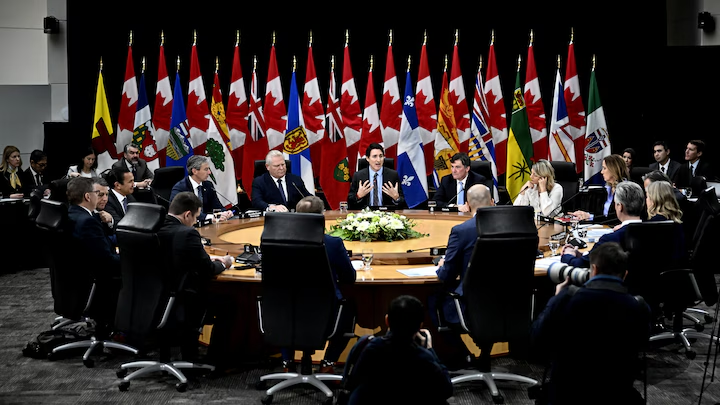
t the grandly named “Council of the Federation” – periodic meetings of Canada’s First Ministers – some issues come and go: passport processing times (2003-04), a national framework for daycare (2004-05), harmonized securities regulation (2010-11), coordination of the COVID-19 pandemic response (2020-23). Others come up repeatedly, with no satisfactory resolution ever decided. Equalization falls squarely into the latter category.
Writing in Federalist No. 21, Alexander Hamilton sets to work diagnosing “the most important … defects that have hitherto disappointed our hopes for the system established among ourselves,” referring specifically to the Articles of Confederation. In that loose post-Revolution alliance of the Thirteen States, Hamilton identifies three otherwise fatal flaws that would be fixed with the adoption of the new Constitution. These include the utter lack of power to enforce commitments made among the states, the absence of a “mutual guaranty” of internal stability within the federation, and inequities in how the States contributed to the common treasury.
What may read at first like a list of early American resentments echoes, almost prophetically, in Canada’s debates over equalization. Each of Hamilton’s points finds a modern parallel in that longstanding source of friction among Our Canadian Provinces.
At Canada’s founding, what became the four Provinces all depended heavily on revenue generated through tariffs to fund their own priorities. Joining Confederation meant ceding that power to the new federal government. There was a need, therefore, to ensure not only that the Provinces were able to retain some measure of fiscal autonomy but also that tax revenue would be fairly distributed within the greater federation.
Unlike the American Articles of Confederation – providing, in Hamilton’s phrasing, a “total want of SANCTION to its laws” – Canada’s Constitution Act of 1867 enshrined these obligations among the Provinces and made them enforceable.1 Section 118 set out a payment schedule according to which the four Provinces were to be provided annual grants from the federal government “for the Support of their Governments and Legislatures.” The redistribution of federal revenues was central to the original vision of Confederation.
Ontario, for example, was to be granted the largest sum, followed by Québec and the two Atlantic Provinces. Recognizing the fiscal vulnerability of New Brunswick, an additional annual grant was to be provided to that Province for the first ten years following Confederation, a measure intended to guarantee a basic level of equity. That same principle was built into an escalator clause for determining future sums, which would be calculated on a per-capita basis. In an effort to forestall future conflict, population floors were guaranteed to Nova Scotia and New Brunswick, both of which had far fewer subjects compared to Ontario and Québec.
The level of technical detail in the Constitution Act suggests that Canada’s founders viewed the stability of Our federation in largely fiscal terms. Additional amendments were made to Section 118 following the entrance into Confederation of Manitoba (1870), British Columbia (1871), Prince Edward Island (1873), Alberta (1905), and Saskatchewan (1905). By 1907, Section 118 had been expanded to include population brackets, guaranteed per-capita rates, special term-limited payments to individual Provinces, half-yearly payment schedules, calculations for interest payments, and conditions under which the federal government was allowed to make deductions to transfer payments.
In true British form, Canada’s Constitution had grown into something of a contract between the federal government and the Provinces, one not entirely unlike Magna Carta or the English Bill of Rights. Notably, the amendments of 1907 expanded the purpose of transfer payments. Originally meant to support the basic functions of government, now they were to include support for other “local purposes.” That concept would later be expanded further still under Section 36 of the Constitution Act of 1982 guaranteeing to all Canadians, no matter their Province of residence, “reasonably comparable levels of public services at reasonably comparable levels of taxation.”
Hence equalization, Our Dominion’s own version of Hamilton’s mutual guarantee of internal stability. But whereas Canada’s developed in terms of fiscal stability and equity, the American Framers saw greater risks in rebellion, insurrection, and tyranny. Stability in their Union would require something quite different.
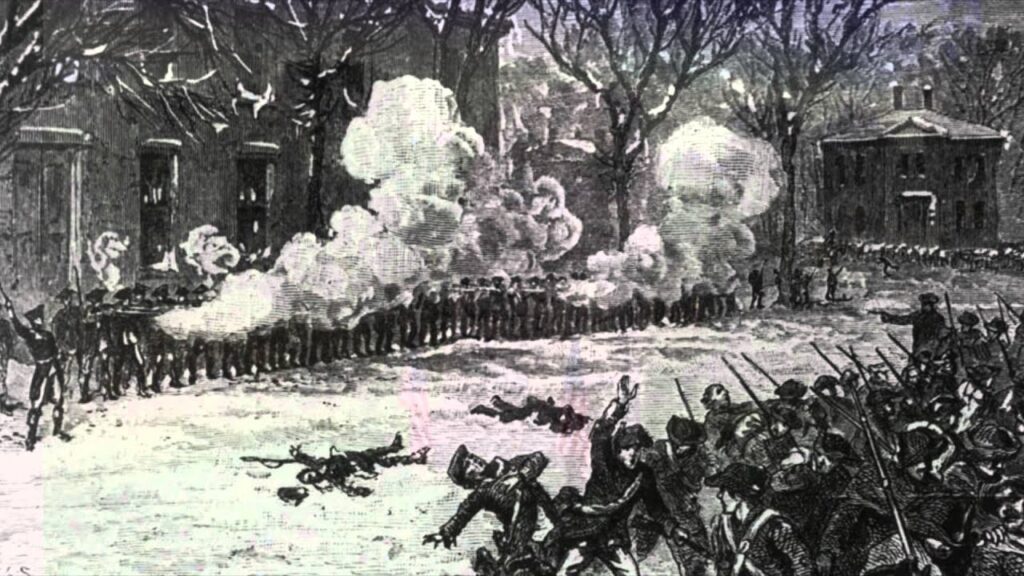
Hamilton wrote Federalist No. 21 not long after Shays’s Rebellion in Massachusetts, a popular uprising sparked by a debt crisis and – true to American form – the State’s taxation policies. The rebellion had only just been put down by the state militia, and Hamilton worries in this paper that the “tempestuous situation from which Massachusetts has scarcely emerged” might easily have threatened the security of the whole of the Thirteen States. “Who can determine,” he asks,
what might have been the issue of her late convulsions, if the malcontents had been headed by a Caesar or by a Cromwell? Who can predict what effect a despotism, established in Massachusetts, would have upon the liberties of New Hampshire or Rhode Island, of Connecticut or New York?
For Hamilton, the mutual guarantee of the Union was fundamentally about maintaining political order under republican government.2 For Sir John A. and the other Fathers of Canadian Confederation, Ours was about fiscal stability and loyalty to the long and peaceable continuity of the Crown.3
While the potential consequences of Shays’s Rebellion were clearly at the forefront of Hamilton’s mind, there was perhaps a deeper concern lurking in the back of it. The Framers had been unable to come to a resolution at Philadelphia on the question of slavery, and it remained a growing source of tension within the Union after the adoption of the Constitution. Were there to be a violent uprising, led by the likes of a Caesar or a Cromwell, as Hamilton worried – or of a Robert E. Lee, which he may well have imagined – the federal government under the decentralized Articles of Confederation would be powerless to restore order.
In that case, the promise of the Revolution would be lost, as it very nearly was at the Second Battle of Bull Run in 1862. For Canadians at Charlottetown two years later, however, contentious debates over human bondage, provincial powers vis-à-vis the federal government, and the role of standing armies had already been settled. Slavery was abolished throughout the British Empire in 1834; the bloodbath that was the American Civil War showed the risks of a weak central government; and the vulnerability of a fragmented British North America in the face of an expansionist United States had been evident from the War of 1812 onward. Our Dominion’s mutual guarantee was not to be poetry written in the blood of conflict but rather the pragmatic prose of fiscal federalism.

And yet the lessons of the American constitutional debates still resonate on this preoccupation of Our Provinces. Hamilton moves on to his third point: “The principle of regulating the contributions of the States to the common treasury by QUOTAS is another fundamental error” that needs to be rectified by the new Constitution.4 Under the Articles of Confederation, member States were assigned specific amounts that they were to pay to the common treasury to fund their loose federation. Because the federal government had no powers of taxation in its own right, funds had to be requisitioned from the States based loosely on their ability to pay.
The problem, as Hamilton saw it, was that “the wealth of nations depends upon an infinite variety of causes.” He goes on to elaborate:
Situation, soil, climate, the nature of the productions, the nature of the government, the genius of the citizens, the degree of information they possess, the state of commerce, of arts, of industry,—these circumstances and many more, too complex, minute, or adventitious to admit of a particular specification, occasion differences hardly conceivable in the relative opulence and riches of different countries.
In other words, there is no sure way to guarantee equity among the States on the point of fiscal federalism – some may be assessed at rates that exceed their ability to pay, others at rates too low to be fair. Hamilton concludes that “no general or stationary rule by which the ability of a state to pay taxes can be determined.” For this reason, he argues that the only equitable solution is to grant the federal government its own powers of taxation so that it can directly raise the funds it needs to maintain the Union.5
While Canada’s Founders drew the same conclusion that Our federal government must have robust powers of taxation in its own right, they arrived there in a way that was rooted in the principles of British equity. It was essential to balance the fiscal interests of each Province in order to guarantee to all the same level of stability and security. The case of New Brunswick compared to Ontario in 1867 made plain that very point. Why, after all, should Ontario – or, later, Alberta – consent to join Confederation only to subsidize those Provinces that were less well off than themselves? The Fathers of Confederation might have responded, Aequitas est vinculum societatis: Equity is the bond of society.6
By enshrining an early form of equalization alongside the federal government’s own powers of taxation, Canada’s Founders meant to signal a commitment to equity among Our diverse Provinces. And yet in keeping with the nature and traditions of equity, no specific terms were set in the Constitution of 1982 to achieve what Section 36 promises. In response, successive governments have engaged in the very fool’s errand that Hamilton warned against: they have attempted to formulate a complete set of factors that will guarantee just and equitable outcomes when it comes to the redistribution of the federal government’s tax revenue.
The concept at the heart of equalization is “fiscal capacity,” which is to say the theoretical ability of a Province to raise revenues given its tax base. Provinces with higher unemployment or lower average property values, for example, will tend to have reduced fiscal capacity compared to others. Fiscal capacity is unrelated to actual revenue; it measures only what revenues could be raised at comparable levels of taxation across jurisdictions. The federal government compares fiscal capacity to actual revenues raised in a given period, then provides grants – out of its own revenues, a point often missed by critics7 – to those provinces that fall below an established national standard. This way, the ability of each Province to provide reasonably comparable standards of services is “equalized” across the federation. Simple.
However, the rise of the welfare state has only led to the multiplication of services that are provided at the provincial level. The growing need for adequate healthcare, education, policing, etc., all factor into the way that a national standard is established, just as demographics, geography, cost of living, etc., all factor into the fiscal capacity needed to provide those services. Attempting to balance these two sets of factors has resulted in an increasingly complex equalization formula – one that has become so incomprehensible that the federal government does not even make it readily accessible to the public.8
Here is the very incoherence Hamilton foresaw: a formula so dense that the government using it cannot adequately explain its own calculations to the public it governs. That opacity has fueled resentment among residents of so-called “have provinces” against the so-called “have-not provinces,” undermining the very concept of equity meant to be enshrined in Section 36. It has also allowed unscrupulous leaders and demagogues to arm themselves with a rhetoric of populist grievance that bears little connection to the facts.
Disaffection with Our Dominion’s framework of fiscal federalism, combined with the futility of reducing equity to a formula, has inflamed resentments that are now corroding the very foundation of Canada’s political order. Whether it be the removal of Canadian flags from provincial buildings in Newfoundland and Labrador in the early 2000s, the nonsensical referendum in Alberta on equalization in 2021, or the din of separatist whisperings in the Prairies and Québec – all are modern illustrations of Hamilton’s warning that efforts to calculate equity would only breed jealousy and invite discord.

The idea that the multiplicity of factors that equity must weigh can be reduced to a mere formula is anathema to the very concept of equity itself. Such an absurdity, Hamilton wrote, “would of itself be sufficient in America to work the eventual destruction of the Union, if any mode of enforcing a compliance with its requisitions could be devised.” Canada’s founding on the principle of fiscal equity was never intended to create competing ledgers of debits and credits that, in the end, must be made to balance perfectly. Aequitas spectat intentionem, non formam: Equity looks to the intent, not the form.
Canada, indeed, was founded as a refuge of law and order, of liberty and property, of justice and equity; it was founded as a Dominion of the Crown, by those loyal to it, for the people under it. May that allegiance never perish from the earth. ♛


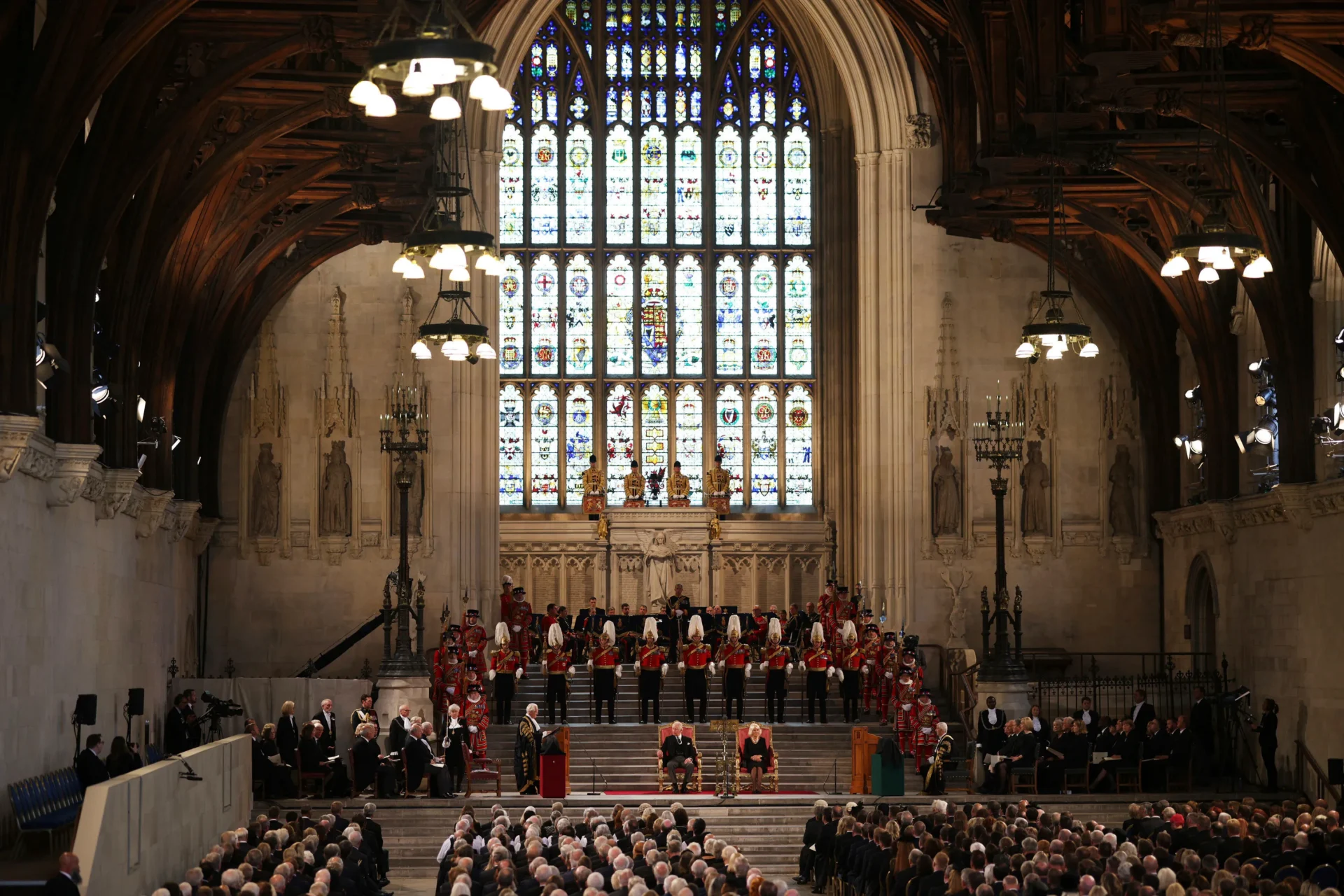
Cover image: Westminster Hall during the lying-in-state of Her Majesty the late Queen Elizabeth II, marking the end of the Second Elizabethan Age. From the early fourteenth century until the late nineteenth, the ancient hall was the meeting place of the Court of Chancery, where England’s maxims of equity were forged. Photo by Dan Kitwood/Pool Photo via AP (2022).
Footnotes
- Equitas in executivis vigilat. (“Equity is vigilant in enforcement.” —Ed.)
- See Article IV, Section 4: “The United States shall guarantee to every State in this Union a Republican Form of Government, and shall protect each of them against Invasion; and on Application of the Legislature, or of the Executive (when the Legislature cannot be convened) against domestic Violence.”
- Aequitas sequitur legem. (“Equity follows the law.” —Ed.)
- Aequitas in omnibus rebus praestat. (“Equity is equality in all things.” —Ed.)
- See Article I, Section 8, Clause 1: “The Congress shall have Power to lay and collect Taxes, Duties, Imposts and Excises, to pay the Debts and provide for the common Defence and general Welfare of the United States; but all Duties, Imposts and Excises shall be uniform throughout the United States.” The Sixteenth Amendment later clarified that these powers extended to the collection of income taxes “without apportionment among the several States.”
- It must be noted that Gloriana here appears to be taking some poetic licence, as this is not a canonical maxim of equity. —Ed.
- See especially Stephen Maher’s article on the subject, “In Defence of Equalization,” published in Maclean’s Magazine in 2019.
- From the Government of Canada’s page on equalization: “The detailed Equalization calculations are shared with provinces and academics, and with anyone who requests them.”